

THE SHIFT PERFORMANCE STACK
Coffee, Creatine & Electrolytes: What Actually Works—and What Doesn't
A Baseline Brief
First, a genuine thank-you to FireHaus Supplements.
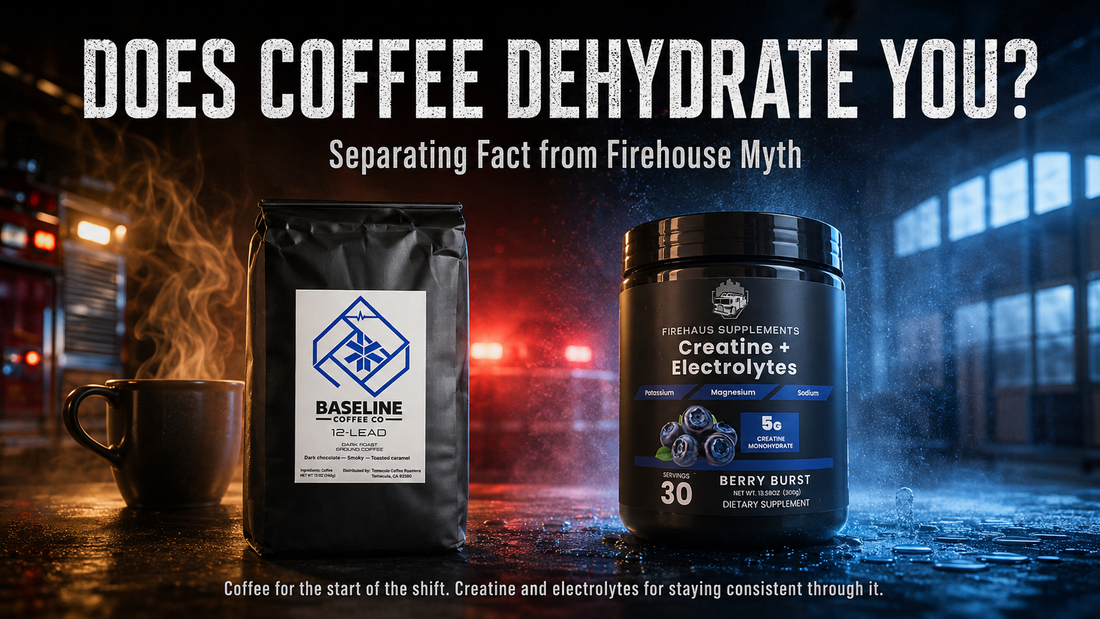
FireHaus recently featured Baseline Coffee Co. in their article addressing one of the most common myths surrounding coffee and hydration: does coffee actually dehydrate you?
But what stood out wasn't just the mention.
It was the approach.
Instead of relying on supplement-industry hype or repeating the same firehouse myths we've all heard for years, FireHaus took an evidence-based look at coffee, hydration, electrolytes, and creatine—and where each one actually fits.
That's a conversation worth continuing.
Because for people working long shifts, training between days off, sweating through calls, wearing gear, functioning on interrupted sleep, and trying to stay physically capable for the job, the question shouldn't be:
What's the magic product?
There isn't one.
The better question is:
What does each tool actually do—and how do you use it intelligently?
Coffee. Creatine. Water. Electrolytes.
They all have a place.
But they don't all do the same job.
☕ COFFEE: MORE THAN JUST "I NEED ENERGY"
Let's start with the obvious one.
Coffee and shift work have been together forever.
Early starts. Late reports. Interrupted nights. The 0200 call that turns into paperwork at 0430. The morning after you technically slept—but nobody would describe it as restful.
Coffee is part of the culture.
But caffeine isn't magic.
Caffeine works primarily by blocking adenosine receptors in the brain. Adenosine is involved in building sleep pressure—the longer you're awake, the more that pressure generally builds.
Caffeine doesn't eliminate the need for sleep.
It temporarily interferes with the signal telling you that you're tired.
That distinction matters.
When used appropriately, caffeine can support alertness, vigilance, and reduce the perception of fatigue. It may also improve aspects of physical performance.
The practical takeaway:
Coffee can help you perform while you're tired.
It cannot make you recovered.
That's an important difference for shift workers.
MYTH #1: "COFFEE DEHYDRATES YOU"
This one has probably been repeated in more stations than almost any other coffee myth.
"You drink coffee? Better drink twice as much water."
Not exactly.
Yes, caffeine can have a mild diuretic effect, particularly at higher doses or in people who aren't accustomed to caffeine.
But increased urine production is not automatically the same thing as meaningful dehydration.
Moderate coffee consumption can contribute to daily fluid intake. The water used to make coffee still counts as fluid.
That doesn't mean coffee replaces an actual hydration strategy.
Those are two completely different statements.
A cup of coffee during a normal day?
It counts.
Coffee before training?
Still provides fluid.
Coffee during a long shift?
Also contributes fluid.
But if you've spent hours in the heat, worked a prolonged incident, trained hard, or sweated heavily in bunker gear, coffee isn't suddenly the complete answer to replacing what you've lost.
Enjoy your coffee.
Drink your water.
Know the difference.
⚡ CAFFEINE: THE TOOL EVERYONE USES—BUT FEW PEOPLE MANAGE
The problem usually isn't coffee.
The problem is often how we use caffeine.
There is a major difference between:
Using caffeine strategically
and
Panic-drinking caffeine every time you feel tired.
We've all seen it.
Start the shift with coffee.
Another cup mid-morning.
An energy drink after lunch.
Pre-workout before training.
Another coffee later that night.
Then wonder why sleep is terrible when the shift finally ends.
Caffeine can absolutely be useful.
But timing matters.
Dose matters.
Individual tolerance matters.
And sleep matters.
More caffeine doesn't automatically mean better performance.
At a certain point, more can simply mean jitters, anxiety, gastrointestinal issues, increased heart rate, and worse sleep.
Here's the question worth asking:
Is this caffeine helping me manage the shift—or creating another problem I'm going to have to manage later?
For someone heading into a demanding period of work, caffeine may make sense.
For someone preparing for training, it may be useful.
For someone trying to maintain alertness during a long night?
It can absolutely be a useful tool.
But if you're nearing the end of your shift and hoping to sleep soon after getting home, that late caffeine dose deserves some thought.
Coffee can help you stay awake.
It cannot replace sleep.
No supplement can.
🧠 CREATINE: ONE OF THE MOST STUDIED SUPPLEMENTS—AND STILL ONE OF THE MOST MISUNDERSTOOD
If there were a Hall of Fame for misunderstood supplements, creatine would probably be first ballot.
Despite decades of research, people are still asking:
"Isn't that basically a steroid?"
No.
"Doesn't it destroy your kidneys?"
Not in healthy individuals using appropriate amounts, based on current evidence.
"Don't you have to cycle it?"
No.
"Do I only take it on workout days?"
Also no.
Creatine is a naturally occurring compound involved in the body's energy systems.
Supplemental creatine increases the amount of creatine available in muscle, supporting the phosphocreatine energy system—an important energy system for short-duration, high-intensity efforts.
That makes sense for activities involving repeated bursts of demanding work.
Think:
Heavy lifting
Carrying equipment
Dragging
Climbing
Sprinting
Strength training
Repeated high-intensity efforts
Creatine is one of the most extensively researched supplements available and has consistently demonstrated benefits for strength, power, and repeated high-intensity exercise.
For first responders who train regularly, that matters.
The job may not look like a gym program.
But physical performance often requires strength, power, work capacity, and the ability to repeatedly perform demanding tasks.
Creatine isn't going to make you fit.
It won't replace training.
But it can be a useful tool supporting the work you're already putting in.
MYTH #2: "CREATINE IS A STEROID"
Let's make this one simple.
Creatine is not a steroid.
They are entirely different substances with entirely different mechanisms.
Calling creatine a steroid is simply incorrect.
MYTH #3: "YOU HAVE TO CYCLE CREATINE"
No.
Creatine works by increasing creatine stores in muscle over time.
Consistency is the important part.
A loading phase can increase muscle creatine stores more quickly, but it isn't required for creatine to be effective.
For most people, a consistent daily routine is more important than obsessing over the perfect timing.
Daily consistency beats complicated supplementation.
MYTH #4: "ONLY TAKE CREATINE ON WORKOUT DAYS"
Also no.
Creatine isn't like a shot of caffeine that you take immediately before you need the effect.
Its benefits are tied to consistently maintaining elevated creatine stores.
That means your routine shouldn't disappear because:
You're off shift.
It's a rest day.
You didn't make it to the gym.
You spent the day recovering on the couch.
Keep it simple.
Stay consistent.
MYTH #5: "CREATINE MAKES YOU FAT"
Creatine can cause an increase in body weight.
That doesn't automatically mean body fat.
One reason is increased water stored within muscle tissue.
The number on the scale may change without meaning you've gained fat.
The scale doesn't always tell the whole story.
MYTH #6: "CREATINE WILL DEHYDRATE YOU OR MAKE YOU OVERHEAT"
This myth is particularly relevant to firefighters and anyone working in hot environments.
The concern has existed for years: if creatine affects water distribution in the body, does that somehow increase dehydration or heat-related risk?
Current research does not support the idea that appropriate creatine supplementation inherently causes dehydration or makes healthy users less tolerant of heat.
That does not mean hydration suddenly becomes optional.
If you're sweating heavily, working in heat, or wearing significant protective equipment, you still need an appropriate hydration strategy.
Creatine doesn't replace water.
Water doesn't always replace electrolytes when significant sweat losses occur.
And electrolytes don't replace good decision-making.
Again:
Different tools. Different jobs.
💧 ELECTROLYTES: USEFUL—BUT NOT MAGIC
Electrolytes have become one of the biggest things in modern hydration marketing.
Apparently, we're now supposed to believe every bottle of water requires a packet, powder, tablet, scoop, or proprietary blend.
Reality is a little less exciting.
Electrolytes are minerals involved in important physiological processes, including fluid balance and normal nerve and muscle function.
They can be particularly useful when you're losing substantial amounts through sweat.
That can include:
Hot-weather operations
Wildland work
Long-duration incidents
Hard physical training
Extended periods of heavy sweating
Long shifts with significant environmental demands
But that doesn't mean every person needs to aggressively supplement electrolytes all day while sitting in climate-controlled quarters.
More isn't automatically better.
The need for electrolyte replacement depends on the situation.
How much are you sweating?
How long have you been working?
What's the environment?
What are you actually losing?
Your hydration strategy should respond to the demands you're facing—not whatever supplement marketing tells you to do.
MYTH #7: "MORE ELECTROLYTES = BETTER HYDRATION"
Not necessarily.
Electrolytes can be useful.
That doesn't make unlimited electrolyte intake better.
The goal isn't to consume as much sodium, potassium, magnesium, or anything else as possible.
The goal is to appropriately support fluid and electrolyte needs based on the demands placed on your body.
For normal daily life, water and a balanced diet may be sufficient for many people.
For significant heat exposure and sweat losses?
Electrolytes can become much more relevant.
Context matters.
It almost always does.
☕ + 🧠 CAN YOU TAKE COFFEE AND CREATINE TOGETHER?
Another question that comes up constantly:
"Does caffeine cancel out creatine?"
The short answer?
It's not that simple.
Research examining caffeine and creatine together has produced mixed findings.
Some research has suggested potential interactions under certain conditions, while other research has found no meaningful interference.
For the average person, that doesn't mean you need a complicated schedule involving six alarms and three different shaker bottles.
The practical approach is straightforward:
Take creatine consistently.
Use caffeine according to your tolerance and schedule.
If taking them together causes stomach discomfort, separate them.
Don't turn a simple routine into a science experiment unless there's a reason to.
🔥 THE SHIFT PERFORMANCE STACK
So how does this actually work in real life?
Not in a laboratory.
Not in an Instagram ad.
On shift.
Here's a practical way to think about it.
START OF SHIFT
☕ Coffee
If coffee fits your routine and tolerance, this is where it can make sense.
Use it to support alertness and performance—not because you're convinced caffeine somehow replaces sleep.
Enjoy the ritual.
Enjoy the coffee.
Use caffeine intelligently.
EVERY DAY
🧠 Creatine
Consistency matters more than perfect timing.
You don't need to wait for a workout.
You don't need to save it for shift days.
You don't need to overcomplicate the process.
Make it part of a routine you can actually maintain.
HEAT, SWEAT & HEAVY WORK
💧 Water + Electrolytes
This is where your hydration strategy becomes more important.
If the environment is hot, you're sweating heavily, you're training hard, or you're working for an extended period, pay attention to replacing fluids and—when appropriate—electrolytes.
Coffee can still be coffee.
But coffee isn't the whole hydration plan.
LATE SHIFT
⚡ Think Before Automatically Reaching for More Caffeine
This is the part shift workers often ignore.
That cup of coffee at the right time can help you.
That same caffeine dose at the wrong time can make your recovery sleep worse.
Sometimes the question isn't:
"Will this help me stay awake?"
Of course it might.
The better question is:
"What is this going to cost me when I finally get the opportunity to sleep?"
That's part of managing caffeine—not fearing it.
🚨 THE BIGGEST MYTH OF ALL: YOU CAN'T SUPPLEMENT YOUR WAY OUT OF BAD FUNDAMENTALS
Here's the part nobody likes hearing.
The perfect coffee won't fix chronic sleep deprivation.
Creatine won't replace training.
Electrolytes won't fix a consistently poor diet.
A pre-workout won't replace conditioning.
And another scoop, packet, capsule, or cup won't undo weeks of ignoring the basics.
Supplements and performance tools work best when they're supporting a foundation.
That foundation is still:
Sleep when you can get it
Quality nutrition
Consistent training
Appropriate hydration
Recovery
Managing stress
Building physical capacity over time
The basics aren't exciting.
They're just effective.
And that's probably why people keep looking for something more complicated.
THE BOTTOM LINE
Coffee.
Creatine.
Electrolytes.
All useful.
None magic.
Coffee can support alertness and performance.
Creatine is one of the most extensively studied supplements available for supporting strength, power, and repeated high-intensity performance.
Electrolytes can play an important role when sweat and environmental demands increase.
But they are not interchangeable.
And they don't replace the fundamentals.
The smartest approach isn't finding the biggest stack.
It's understanding what each tool actually does.
Use coffee for what coffee does well.
Use creatine consistently.
Use electrolytes strategically.
Drink water.
Train.
Recover when you can.
And stop expecting one product to fix everything the job throws at you.
Coffee for the shift.
Creatine for consistency.
Electrolytes when the demand calls for them.
The fundamentals for everything else.

MEET FIREHAUS SUPPLEMENTS
Built by a firefighter. Built with purpose.
Before we wrap up, we want to give credit where it's due.
FireHaus Supplements is a supplement company built from firsthand experience in the fire service. Founded by a firefighter with more than 15 years in the profession, FireHaus was created around a simple idea: develop quality supplements for people who demand a lot from themselves—whether that's on the fireground, in the gym, or simply trying to stay ready for the next shift.
What we appreciate about FireHaus is the approach.
There is no shortage of supplement companies willing to make big promises, throw around buzzwords, and sell you a complicated stack you probably don't need.
FireHaus takes a different approach.
Their educational content focuses on understanding why something works—not simply telling you that you need it.
That's exactly the kind of conversation we want to see more of in the first responder community.
And there's another reason we wanted to highlight them.
They give back.
A portion of FireHaus sales goes directly toward supporting first responders and first-responder causes. So when you support a company like FireHaus, you're not just buying a supplement from another faceless brand. You're supporting a company that was built inside the culture and continues to invest back into the people who serve.
That matters to us.
Because we're big believers that the companies serving this community should actually be part of the community.
Our recommendation?
If you're a first responder, firefighter, medic, or just someone looking for a supplement company that understands the demands of an active lifestyle, take a look at FireHaus Supplements.
Do your research. Know what you're taking. Understand why you're taking it.
But if you're looking for a place to start, we'd be comfortable pointing you toward FireHaus.
Good products. First-responder roots. Education over hype. And a portion of every sale going back to the people who serve.
That's a company worth supporting.
Check them out: FireHaus Supplements
Once again, thank you to FireHaus Supplements for featuring Baseline Coffee Co. and helping start the conversation with an evidence-based look at one of the most common myths surrounding coffee and hydration.
Their article, Does Coffee Dehydrate You? Separating Fact from Firehouse Myth, is worth reading—especially if you've ever heard someone tell you that every cup of coffee needs to be "paid back" with two bottles of water.
The best conversations about first responder health and performance shouldn't be built around hype.
They should be built around education.
And we're always good with continuing that conversation.
SOURCES & FURTHER READING
For readers interested in learning more, consider reviewing evidence-based resources from organizations such as:
National Institutes of Health Office of Dietary Supplements — Exercise and Athletic Performance
International Society of Sports Nutrition position stands and research on creatine supplementation
Peer-reviewed research examining caffeine, hydration, exercise performance, and sleep
FireHaus Supplements — Does Coffee Dehydrate You? Separating Fact from Firehouse Myth
EDUCATIONAL NOTICE
This article is intended for general educational purposes and is not medical advice.
Individual responses to caffeine and supplements vary. People who are sensitive to caffeine, pregnant, managing kidney disease or other medical conditions, or taking medications should speak with an appropriately qualified healthcare professional before making significant changes to caffeine or supplement use.